Key findings
OpenAI announcement, product page and help center · re-checked Nov 17, 2026
Does claiming get you recommended?: No OpenAI says claiming does not guarantee higher placement or sales.
Claim your profile this week. Then do the work that gets you named in the answer, because claiming alone won't.
Nov 10
Businesses in ChatGPT (beta)
Claim a profile, update details, and see mentions and website clicks
Existing U.S. listings
Local stores and restaurants
They can claim a listing that already exists, not create a new one
After you're named
When a Business Agent can appear
Eligible U.S. ecommerce and online-service businesses. Outside ads, the chat starts only after you show up in an answer.
ChatGPT Business Hub went live on November 10. Claiming your profile won't get you recommended, and OpenAI says so in writing.
OpenAI launched Businesses in ChatGPT in beta that day. Through ChatGPT Business Hub you can claim a profile, keep your details current, add a product feed with pricing and availability, and see aggregated mentions and website clicks. Eligible U.S. ecommerce and online-service businesses can also publish a Business Agent, a labeled chat that answers questions about what you offer.
It's worth claiming. It's also easy to misread what you get. OpenAI's product page says ChatGPT continues to make independent recommendations and comparisons, and that claiming does not guarantee higher placement or sales. The profile lets you manage what you submit. It doesn't decide whether you're named when a buyer asks who to call, hire or buy from.
What launched#
There are two products in this announcement, and they work differently.
The first is ChatGPT Business Hub. After you claim your business and complete verification, you can update key details and, if you sell products, connect a feed with pricing and availability. ChatGPT may use that information when it answers questions about you. You also get a 28-day view of mentions, website clicks and discovery topics, which are the common themes in answers that mentioned or cited you. OpenAI aggregates those numbers, shows them only once activity passes a threshold, and doesn't share individual conversations.
The second is Business Agents. After the same claim and verification, eligible businesses can build, test and publish an agent that answers customer questions from the information and guidelines you give it. When your business appears in an answer, a person can open your ChatGPT profile and choose to start that chat. OpenAI labels the agent conversation and keeps it separate from the person's original thread and from ChatGPT's own answers.
You don't need an ads account or a ChatGPT Enterprise agreement to claim an eligible business. Existing Enterprise customers and advertisers can go through their OpenAI representative, and online stores can connect their store from Business Hub to speed up verification. The setup steps are in OpenAI's help center.
OpenAI also says 1.2 billion people use ChatGPT each week. That's OpenAI's number, not one we've verified, and it isn't a reason to treat a claimed profile as a ranking lever.
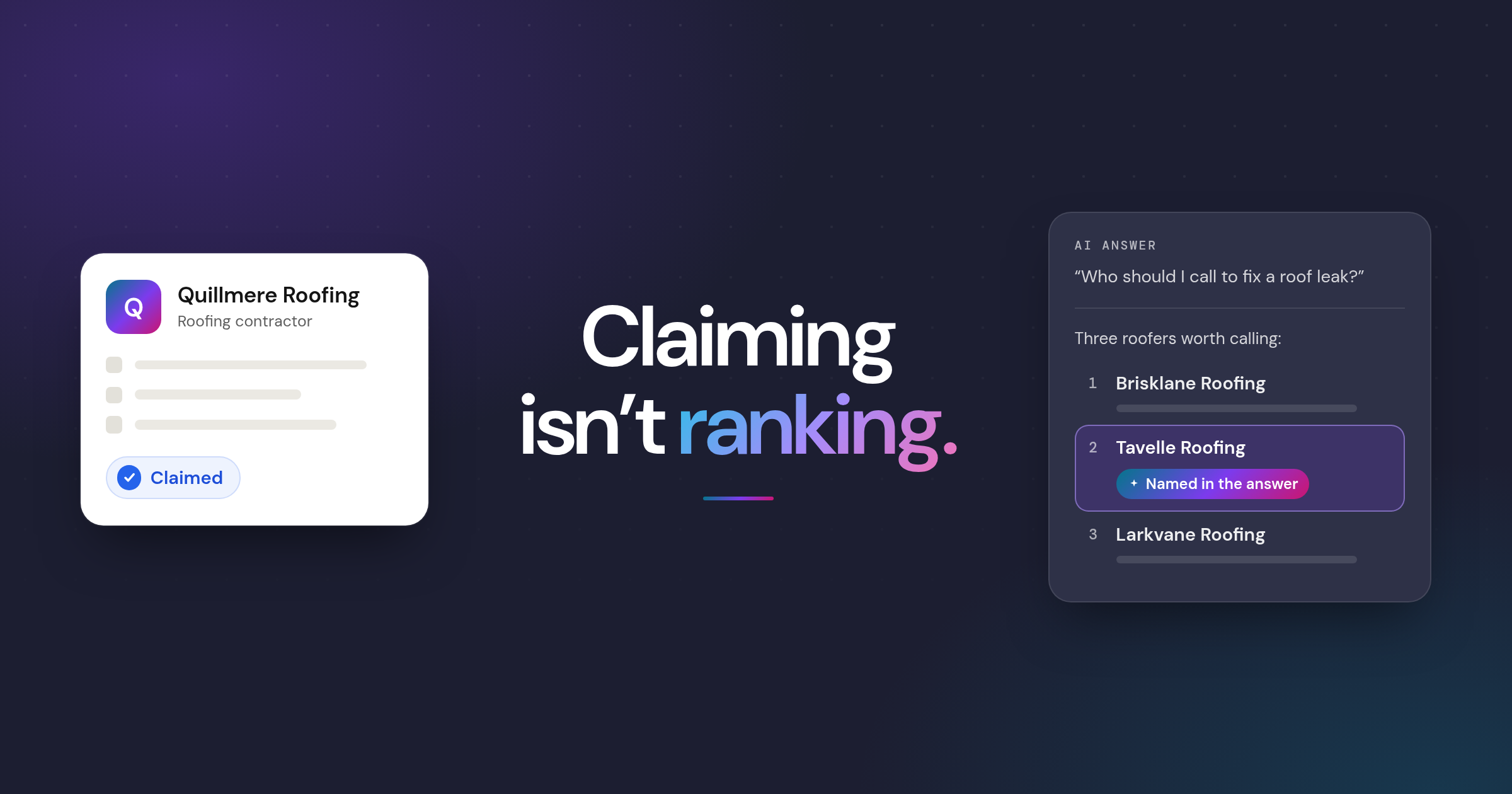
Claiming keeps your record accurate. It doesn't put you in the answer.#
The closest comparison is a Google Business Profile. You prove you represent the business, you correct stale facts, and you get a limited view of how people find you. That comparison holds until you assume claiming the profile is what gets you into the result.
ChatGPT still decides on its own which businesses to name when someone asks a question. Once you're in that answer, a claimed profile keeps your official details current and lets you measure some of what happens next. It doesn't move you onto the shortlist. The help center puts it plainly: claiming lets you manage the information you provide, it doesn't guarantee more visibility, and advertising doesn't influence ChatGPT's independent answers.
The commercial consequence is simple to see. When a buyer asks ChatGPT for a tax firm, a roofer or a brand in your category, the valuable moment is being one of the names in the answer. The profile is what they can open after that. If you aren't named, accurate hours, a clean logo and a clear return policy in Business Hub won't change the outcome.
What the insights can and can't tell you#
The insights are worth having, as long as you read them the way OpenAI defines them.
For an online business, a mention counts only when ChatGPT references your website. Your brand name on its own doesn't count, so an answer can describe you and never show up in your numbers. Local businesses are counted differently. For a local listing, a mention counts when ChatGPT shows a result for that location, even if nobody opens it.
Website clicks are click-throughs to your site. OpenAI doesn't describe them as visits or sales, and you shouldn't read them that way either. If your Insights panel is still blank a week after launch, OpenAI's help center gives three possible reasons: activity hasn't reached the reporting threshold, data is still being collected, or reporting is unavailable. A blank metric doesn't necessarily mean zero activity. Early testers also report that the dashboard doesn't show which competitors were named in the answers where you appeared, so you see your own activity without the comparison a buyer was making.
Use the insights as one signal. A claimed badge isn't proof that you're being recommended.
A checklist for this week#
OpenAI's help center is the source of record. The short version:
- Sign in to ChatGPT, open Business Hub from the sidebar and search for your business by name.
- Select the listing that matches your business and confirm the ChatGPT account you'll use to manage it.
- Verify the claim with one of the methods offered, such as a code to your business phone or email, a DNS text record on your domain, or a connection to your online store.
- Wait for OpenAI to review the claim. You'll get an email with a decision or a request for more information.
- After the claim is approved, complete the separate identity check. You may need a government-issued ID, business registration details and proof that you're authorized to represent the business. Until it's approved you can't publish profile changes, connect a product feed, view insights or create an agent, and the help center says the blue verified check appears only after this step.
- Update the basics first: website, description, category, logo, and any delivery or return policy customers actually ask about. You can also add a cover photo and other optional details. If you sell products, connect a feed only after those details are right.
- If you're eligible for a Business Agent, review the information it will use, test it against questions customers already ask, and publish it only when the answers are accurate. A few limits change the work for local and service businesses. Local stores and restaurants can currently claim only an existing U.S. listing, so if yours isn't there, you may not be able to add it yet. Eligible online businesses may see an option to add a listing where ChatGPT is available and verification is supported.
If someone has already claimed your profile, you can dispute ownership from the profile menu and verify that you're authorized to represent the business. If the listing tells you to contact support, it's locked and you'll need OpenAI's help. OpenAI notes that claiming or disputing a profile doesn't change its visibility.
Edits also take time. OpenAI reviews changes before they appear, and ChatGPT may keep using other sources, so a saved edit doesn't mean every answer reflects it right away.
What actually gets you named#
OpenAI hasn't published a ranking guide for business profiles. If someone tells you a blue check, a product feed or a Business Agent will move you up the list, they're promising something OpenAI has declined to promise.
What we can say from our work on how businesses appear in AI answers is more practical. A model names a business when it can find clear, consistent, citable information about the work that business actually does. So the useful questions are about your public record.
Does your site answer the questions a buyer asks before they choose someone, in enough detail that a model can use the answer? Are your name, category, service area, offerings and credentials consistent everywhere they can be checked? Do you publish facts a model can't get from a generic page in your category, like how you work, how pricing is structured, where you operate and what a customer should expect? And can those facts be found easily, or are they buried, contradicted or missing?
For example, a claimed profile can keep a firm's website and category current once ChatGPT already has a reason to mention it. It can't create that reason. If the public record of the firm is thin, inconsistent or interchangeable with every other firm in the market, the profile won't close that gap.
That's the job of answer engine optimization: make the facts that are specific to you easy to verify and hard to replace, then check whether you actually appear in the answers buyers see. A Business Hub profile is one official source in that picture. Mentions and clicks tell you whether activity is showing up. They don't tell you why you were named, how you were described, or what a buyer would do with that description, and those questions need different evidence.
Business Agents, and where this is heading#
Business Agents are the part of this launch most likely to be oversold, so it helps to be precise.
At launch, they're available to eligible ecommerce and online-service businesses in the United States that have a website and meet OpenAI's industry requirements. Verification alone doesn't make you eligible, and some businesses will be able to manage a profile without being able to publish an agent. OpenAI says it plans to expand to more markets and categories over time.
The current agent can explain your offerings and policies and send someone to your website. It can't complete a purchase, make a booking or look up a customer's order. If you also have a plugin in ChatGPT, the Business Agent chat doesn't use that plugin's data or capabilities.
In September, OpenAI introduced Sponsored Agents for ChatGPT Ads, a labeled conversation that can start from an ad click. We wrote about it when it was announced. OpenAI now says a Business Agent can also be sponsored and used as a destination for ChatGPT Ads, with those placements labeled and kept separate from independent answers. Press reports describe that ad format as a limited test with selected advertisers, so don't assume every claimed business can buy the placement tomorrow.
The direction matches what we described in September. More of the buying conversation is moving inside ChatGPT, closer to the moment a person compares options. A Business Agent is useful at that moment, but it comes after the recommendation. Outside of ads, a customer can only start that chat once your business has appeared in an answer and they've chosen to open your profile. The quality of that conversation depends on the same material as the recommendation: current offerings, clear policies and no invented guarantees.
What would prove this reading wrong? If Business Agents stay a narrow U.S. test and claimed profiles never become part of how people evaluate a business in ChatGPT, the profile is just another directory listing to keep tidy. I don't think that's where this goes, but the product is in beta and OpenAI hasn't published a broader rollout schedule.
FAQ#
Does claiming my business make ChatGPT recommend me more often?#
No. OpenAI says claiming lets you manage the information you provide and doesn't guarantee more visibility, higher placement or sales. ChatGPT keeps making its own recommendations, and OpenAI says advertising doesn't influence them.
Can a local store or restaurant add a new ChatGPT listing?#
Not right now. According to OpenAI's help center, local stores and restaurants can currently claim only an existing U.S. listing. Eligible online businesses may see an option to add one.
Why don't I have a verified badge after I claim my profile?#
Claiming and identity verification are separate steps. The help center says the blue check appears after the identity check is approved. Until then you also can't publish edits, view insights or create an agent.
Who can publish a Business Agent?#
Eligible ecommerce and online-service businesses in the United States with a website that also meet OpenAI's industry requirements. Check agent eligibility separately from profile eligibility before you scope the work.
Can a Business Agent book an appointment or complete a purchase?#
Not in the current version. It can explain products and policies and link to your website, where the customer completes the action.
Do I have to run ads or publish an agent to claim my business?#
No. OpenAI treats claiming, publishing an agent and advertising as separate. Once your claim and identity check are approved, you can manage your information and use the insights without doing either of the other two.
Will insights show me the exact questions people asked?#
No. Discovery topics are aggregate themes from answers that mentioned or cited your business. OpenAI doesn't share individual prompts or Business Agent chats with businesses.
Can I give a teammate or an outside partner access?#
Yes. The admin who claimed the business can add teammates in Business Hub and give an outside partner access to manage the profile or the agent. Each person uses their own ChatGPT account. Don't forward a personal claim invitation to hand someone access.
What to do now#
Claim your profile this week, especially if an existing U.S. listing is sitting there for someone else to take. Keep the details accurate. If you're eligible for an agent, prepare the facts it will use and review its answers before you publish.
Then look at the answers themselves. Ask the questions your buyers ask, in ChatGPT and in the other engines they use, and see whether you're named, how you're described, and what would have to be true on your site for that answer to change. That's the work that gets you into the recommendation. The profile keeps the official record clean once you're there.
If you want to know whether the engines already name you, and what's holding that position up, book an AEO audit.