Yes, AI-assisted content can rank on Google. Google has said so directly: "Appropriate use of AI or automation is not against our guidelines." What it penalizes is content made mainly to manipulate rankings, however it was produced.
That answer is easy to quote and hard to act on. So here's what it looked like on two client sites we relaunched this year with AI-assisted content, what the numbers show, and what they don't.
What Google actually says about AI content#
Google's position has been consistent since early 2023, and its own guide to AI search points the same way. Its ranking systems aim to reward original, high-quality content that shows E-E-A-T: experience, expertise, authoritativeness and trustworthiness. In Google's words, its focus is "on the quality of content, rather than how content is produced." And in its FAQ: "Using AI doesn't give content any special gains. It's just content."
The limit is in Google's spam policies. Scaled content abuse means publishing many pages mainly to rank, with little value for the reader. Google's current guidance on generative AI content (last updated October 1, 2026) says that using AI "to generate many pages without adding value for users may violate" that policy.
The same guidance says it's "critical to manually factcheck and review all AI-generated content for accuracy and trustworthiness before publishing." That review covers more than the article. It includes the page title, meta description, structured data (the code that labels a page for search engines) and image alt text, because all of those can appear in search results.
So by AI-assisted content, we mean writing that AI helped draft and a person with real expertise checked, corrected and approved. That's different from pages published straight from a tool.
Two relaunches, measured#
Both clients are professional services firms in the tax field. One is a law firm that handles IRS disputes. The other is a tax resolution firm. Both got a new website, redirects from their old pages, and new content produced with AI assistance and reviewed before publishing. At the law firm, the firm's own attorneys put their names on the articles.
We measured each site the same way: daily search console data for the 16 months available, comparing the weeks before each relaunch with the weeks after.
The law firm: steady growth, then a record month#
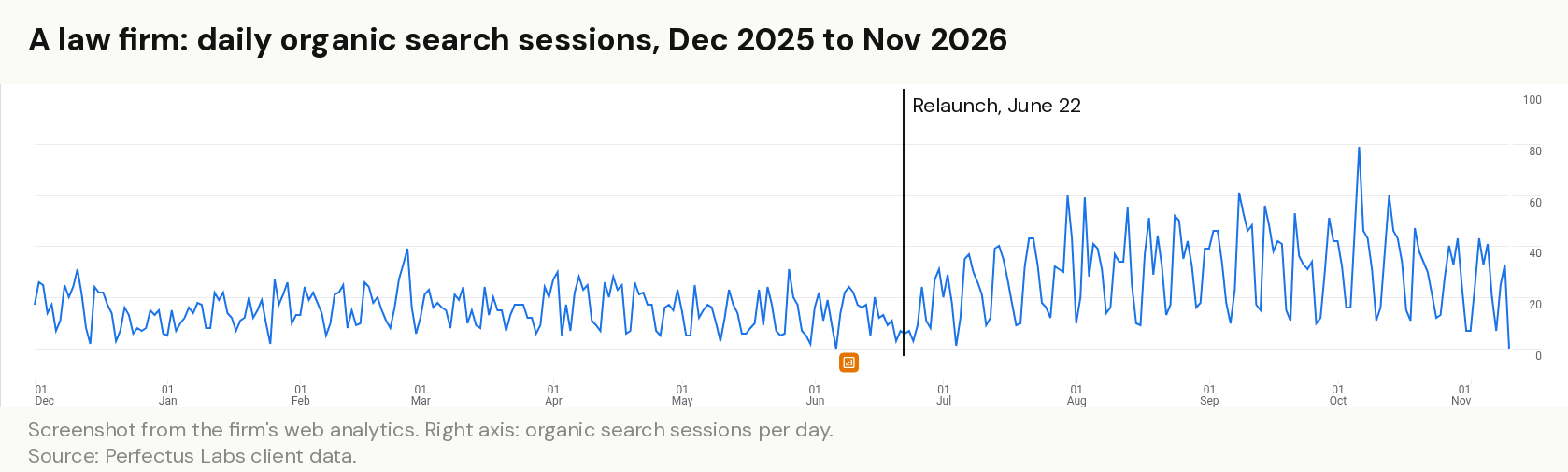
The law firm relaunched on June 22, 2026. In the 12 weeks before, it averaged 12.1 clicks a day from Google search. In the 12 weeks after, it averaged 13.2. That's a modest start, but it matters: the site held its ground through the switch, which is the first thing to check after any relaunch.
The growth came after that. Over the latest eight weeks, from mid-September to early November, the site averaged 19.0 clicks a day. That's 57% above the 12 weeks before the relaunch.
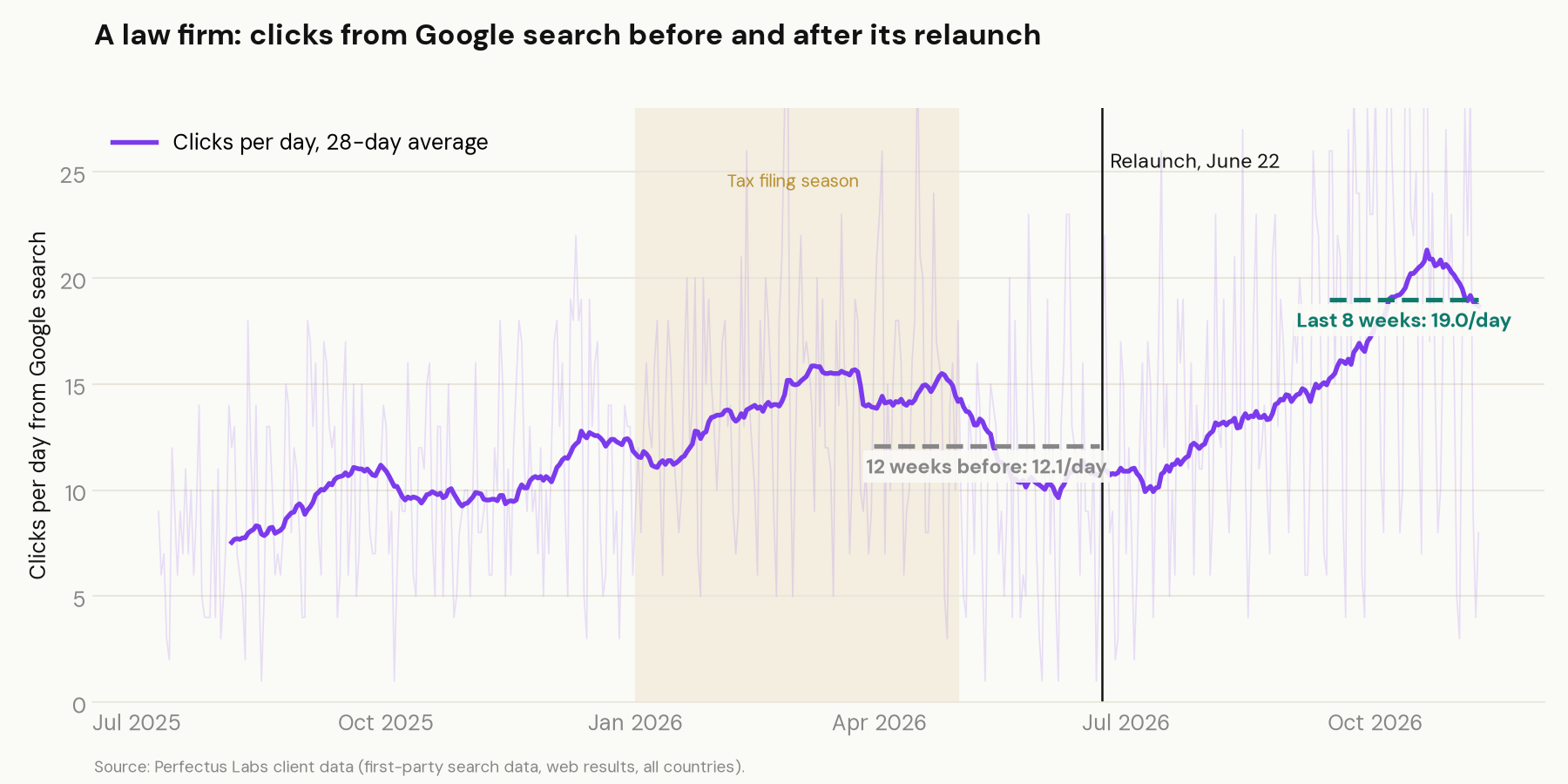
Seasonality matters for a tax firm. January through April is when people file and when tax problems surface, so you'd expect the year to peak then. It didn't. October 2026 brought 618 clicks, the most in any month on record and 39% more than the firm's best tax-season month.
Two other details matter. Impressions, the number of times the site appeared in results, stayed roughly flat. What changed is that more people clicked: the click-through rate rose from 0.51% to 0.83%. That's consistent with pages that answer the question better, not just pages that appear more often.
The site also came through Google's September 2026 spam update, which ran from September 24 to October 8. It earned 245 clicks in the two weeks before the update, 290 during it and 295 in the two weeks after. Our post on the August spam update explains what these updates target.
The firm's web analytics show the same direction. Organic search sessions ran about 15 a day before the relaunch and about 37 a day in October.
The tax resolution firm: no drop, no clear lift yet#
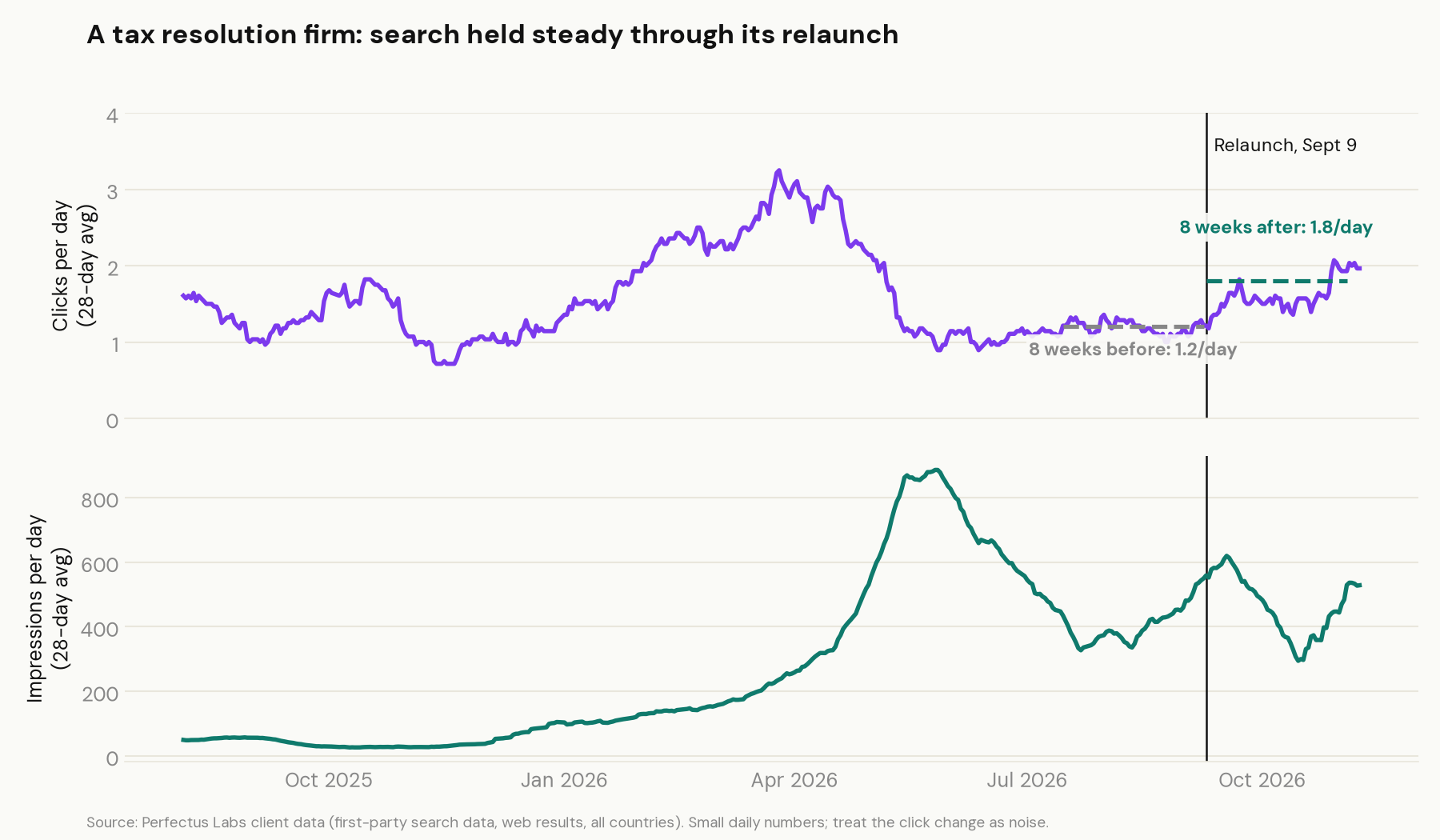
The tax resolution firm relaunched on September 9, 2026, so it has about eight weeks of data since. It earned 70 clicks in the eight weeks before and 99 in the eight weeks after. Impressions held at around 450 to 480 a day.
Those numbers are too small to call a gain, and we won't. What they do show is that a full site replacement with AI-assisted content didn't cost the firm its search visibility, including through the same spam update.
What these results do and don't prove#
A relaunch changes several things at once: the site, its speed, its structure and its content. These results don't show that AI drafting caused the law firm's growth on its own, and we're not claiming that.
They show something narrower and more useful. Two sites published AI-assisted content under a strict review process, went through a full rebuild and a Google spam update, and neither lost ground. One is having its best months on record. That's the outcome Google's guidance predicts when content is useful, whatever tools helped write it.
The OPERA test: five checks before you publish#
The difference between AI-assisted content that works and AI content that gets filtered out comes down to review. We use a five-point check we call the OPERA test.
O: Originality. Does the page say something the top results don't? A tax firm's page on IRS payment plans should explain what the firm sees in real cases, not restate the IRS website.
P: Precision. Is every claim specific and supported? Dollar thresholds, deadlines and form numbers should be checked against the official source, not taken from a draft.
E: Expertise signal. Does the page show first-hand knowledge? An attorney's byline only helps if the attorney actually reviewed the page and would stand behind it.
R: Relevance to intent. Does the page answer the question the searcher asked, in the format they expect? Someone searching "what happens if I ignore an IRS letter" wants the consequences first, not a history of the agency.
A: Accuracy under review. Has a person with subject expertise checked the whole page before it went live, including the title, description, structured data and alt text? AI tools sometimes state wrong facts with confidence. This is where you catch them.
A page that fails two or more checks shouldn't be published, whoever wrote it.
What to do with your own content#
If you're using AI to help produce content, measure it the way we did. Pick a clear before and after date. Compare at least eight weeks on each side, and look at clicks, not just impressions or rankings. Check whether the change holds against your busy season.
If your numbers are flat or falling, look at your review process before blaming the tool. Run your ten most important pages through the OPERA test. The pages that fail on precision or accuracy are the ones to fix first.
How we do this#
Every piece of content we produce for clients is reviewed and approved before it's published, and our AEO audit is where that work starts. We run your customers' real questions through AI assistants, record the answers and sources, and crawl your site for the issues that keep pages from being found or cited. If you want to know whether your content is helping or holding you back, request an AEO audit.